With thanx to
Elyce Rae Helford!
A Long, Hard Review of Fight Club
Ok, so it took me six years to get up the gumption to put myself through the film Fight Club. I knew it would mess with my adrenalin and energy for the day, and it definitely did. It’s a long film (even longer on DVD), and it definitely needed an editor to trim some of the excess. But that’s about the only negative thing I have to say about it.
Here's what I most loved about it:
(1) Critique of corporate capitalism. The film is all about how it crushes the soul and drives white, middle-class men insane. Oddly, it actually brought The Incredibles to mind for me, with its much-lauded critique of the life of (white, middle-class) men in cubicles. But where The Incredibles argued that there’s a superhero waiting to burst forth from that petty insurance job, Fight Club argues there’s a vulnerable, insecure man, suppressing his desire to do the right thing, wrestling with the contradiction that what is supporting his existence (and encouraging him to buy in at a deeper and deeper level – Ikea!) is what is psychically numbing him and driving him mad.
(2) Masculinity. I have seen few recent films that do white, middle-class heterosexual masculinity this well. From the inability to express emotion without absurdly potent encouragement (testicular cancer group, anyone?) to the need to beat each other up to process said emotions, it's right there. I will also give the film credit for having our increasingly psychotic protagonist encourage men to take it out on each other rather than their wives/girlfriends, but that leads me to several other points…
(3) Freud! This film was such a great exemplification of Freud’s “Latency Period,” where boys hang with boys in “No Girls Allowed’ clubs (perfect that our hero called it “Fight Club,” which was so geeky and pre-teen, even if he later “grew up” to form his “army”) and are far less concerned with sex than camaraderie. (That the protagonist wanted to beat up William Shatner was so perfect: the original Star Trek series can be read beautifully as a Freudian latency narrative—see Ilsa Bick’s chapter in Enterprise Zones: Critical Positions on Star Trek (a collection I co-edited in 1996).) It is latency that explains why there is no killing in the film (by the narrator or his "army"). This was a truly surprising element of the film and inexplicable to me without this helpful Freudian framework.
This is also where Marla (Helena Bonham Carter’s character) becomes necessary: she is woman and disrupts the illusion of idyllic boyhood (a la Peter Pan). She forces him to see the pleasures of adult malehood that war with the narrator bond with his “imaginary friend” Tyler Durden and their boyish games. (And the narrator does say something about being a 30-year-old boy or the like, I believe.)
Furthermore, Tyler Durden is phallus personified, and there are all the guns (especially in the narrator’s mouth) as well as the constant castration issues (no coincidence that the threat to the city official is to cut off his balls, nor that if the narrator/Tyler tries to back out of his plan that his army has been commanded to castrate him). Which leads me to…
(4) The Gaze. Fight Club is amazing as it engages with Laura Mulvey’s concept of the “male gaze” in film. Using Freud, Mulvey argues that mainstream films are driven by a libidinal/political economy of constant castration anxiety. Basically, we see the film’s through the male director and male protagonists’ eyes, and these eyes are full of fear of castration (seeing woman-as-difference, he sees that she hasn’t got a dick/balls and realizes his could be taken!). Though castration anxiety can’t be processed consciously, unconsciously it can be resolved, says Freud, through either scopophilic pleasure (turning the threatening object, woman, into a pleasurable object in his control) or a sadistic kind of voyeurism (seeing the woman be controlled or punished, via marriage or murder, for example). And Mulvey argues this drives Hollywood film’s images of women. (To read the article in its entirety, see Mulvey). For Fight Club, the castration stuff couldn’t be any more direct. Marla, then, comes to represent the threat. She is desired object, but the narrator has trouble getting her to fit the fully objectified mold he needs to control the anxiety she brings. She appears in the guise of film noir femme fatale early in the narrative, a figure Mulvey discusses as invoking this threat through her combination of hyperfeminine appearance yet powerful sexuality (and often wielding the phallus/gun). Now, Marla is herself rather castrated, if you will, a pretty poor femme fatale. But she is strong enough to lure and threaten the narrator, who desires her yet cannot manage her. She sees through his masculine guise (showing up at all the support groups he attends) and offers cultural critique (e.g. of bridesmaid’s dresses) and has sex in ways that leave him both part of the experience (via the Tyler persona) and an alienated, impotent voyeur (as he disassociates from his Tyler persona but cannot fully escape it—staying in a nearby room, according to his delusion). In the end, he is either yelling at her to leave or instructing his army to destroy her (not sure if this means killing her or what…hard to tell given the intentionally confusing nature of the representation of his psychosis). Reading through Mulvey, what we have is a situation in which the narrator can neither make of Marla a controllable sex object or adequately punish her. At the film’s conclusion, it seems he will marry her (or at least this may be his delusion as he is dying), and this is, says Freud, one viable solution to castration anxiety.
What is even more interesting re the gaze than how the film plays it out is how it turns it around. Instead of having a narrator constantly gazing at his femme fatale or sex object (a la Hitchcock’s Vertigo, for one), Fight Club has him gaze at his hypermasculine alter ego, Tyler Durden. Both the protagonist and the camera linger over Brad Pitt and his buff bod—as well as over the many other men who must strip to the waist when they fight and the pumped up army dudes. This goes even further as the film fetishizes blood, scrapes, and bruises (and I’ll get to kinkiness presently), but first…
(4) Queerness. Where to begin? Certainly, there is the ease of reading the film’s central fight metaphor as a homophobic men’s method of displaying/repressing homosexual desire. I’m certainly not the first to read punching as intercourse or spurting blood as ejaculation, and those guys certainly did hug a lot after each bout (not to mention sharing a cigarette and a beer). Then there’s the love relationship between the narrator and Tyler (which turns out to be his alter ego, but as we watch the film for the first time, we don’t know/see that). From Brad Pitt’s arguably gay stylings throughout the film (I dare you to look through the International Male catalog and tell me that’s not where Tyler's clothes came from) to the narrator’s voiceover saying he and his imaginary pal lived like “Ozzie and Harriet” and fear of Marla getting between them, we’ve definitely got some queerness going on. (Here, Marla is the third member of a romantic triangle who is necessary to prevent the consummation of the male-male love axis).
Now, that it is Bob (fabulously played by Meat Loaf) who causes the beginning of the breakdown for the narrator of his dual selves also has good queer overtones. The hypermasculine space of his “paper house” army bunker reinforces his delusions. Nor can Marla, that representative of femininity, do more than just spur it on (see above). But Bob—as he blends masculine and feminine, male and female, in body, voice, and personality—does exemplify that there is more to the psyche than the gendered polar opposites which (in combination with oppressiveness of corporate capitalism for Mr. Average) cause his psychotic break. So when Bob dies, arguably, so does the impenetrability (to use a Freudian term) of his delusion. He no longer has a figure through which to externalize his anxieties. Queerness must be acknowledged not just as a part of Bob, but of himself. (Ok, I’m out on a limb here and trying this out as I write it, but it’s working for me.)
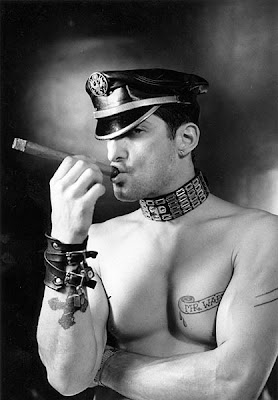
Finally, S/M in the film. The narrator is obviously a masochist, and though it’s not a new image (people into S/M are predominantly psychos in films), Fight Club does seem to me to suggest something more: rigid masculine norms lead to kinky fetishes. If (middle-class) men can’t display emotion (or engage in sex with each other), they can beat each other up. It’s acceptable male display, and you can always pretend it wasn’t sexually arousing (as long as you can keep your erection down). As Steve Neale argues in “Masculinity as Spectacle” (Screen 24.6, 1983, pp. 2-16), “‘male’ genres and films constantly involve sado-masochistic themes, scenes, and phantasies,” and these are “founded upon a repressed homosexual voyeurism.” Neale notes that “in a heterosexual and patriarchal society the male body cannot be marked explicitly as the erotic object of another male look: that look must be motivated in some other way, its erotic component repressed.” In this light, what’s great about Fight Club is that it both illustrates the validity of this argument and shows the consequences (psychosis) for those who do not repress. Gayness and/or queerness aside, the film does more than most in reflecting kinkiness in the blending of pain-pleasure and the enjoyment of showing off of “battle scars.” Indeed, like most who share the BDSM credo of “Safe, Sane, and Consensual,” the Fight Club men in their secret society are even allowed to use safewords (the word “Red” in the BDSM community becomes “Stop” in the film) and, as in BDSM circles where people use pseudonyms (like Tyler Durden) and do not “out” others, the first rule of Fight Club is “You Do Not Talk About Fight Club.” Unlike BDSM, however, male fighting is more marginalized than socially ostracized (as in the scene where the Fight Club members are instructed to pick a fight and have trouble doing so), and so the men do not fear showing off their black eyes and stitches, while those into BDSM, especially women, are unlikely to do the same. (No one accused the narrator of being beat up by his girlfriend, for example.)
All in all, few movies I’ve seen have encouraged me to process (and blog-purge) quite so fully or satisfyingly. I found the film compelling on many levels and regret only that its cultural critique did not seem to sink very deeply into the American consciousness. For one, corporate culture is very good at co-opting critique. For another, most of the men about whom the film speaks most loudly are too busy repressing to get it. Session of Fight Club for Xbox, anyone?


